
By Mark McDowellPosted: Updated: 12 min read
AI Search in Thailand 2026: 10 Findings From 4.3M AI Citations
For 91 days we watched what AI actually said about 203 Thai brands, across every platform that matters here. That gave us 841,358 AI answers and 4,319,764 citations to work from, and ten findings came out clearly.
Key Takeaways
- AI is already how Thais search. 96% of Thai search and AI traffic runs through Google. AI Overviews (the AI answer that now appears at the top of most Google results) sits on top of nearly everything, and AI Mode is rolling out as the next default.
- In every category, AI picks two favourites. The top 2 brands per category get 71% of AI mentions on average. In furniture, it’s 91%. If you’re not in the top 2, AI does not see you.
- AI quotes other people about you, not you. Only 5.7% of what AI says about your brand comes from your own website. The rest comes from Facebook, YouTube, Pantip, Instagram, Reddit, and a Japanese-owned listicle site that almost no one in Thai marketing has heard of.
- Google AI and ChatGPT are not the same game. Only 9 of the top 30 sources overlap between the two. Gemini follows Google AI, ChatGPT goes its own way. You need two playbooks, not one.
The rest of this report is the evidence. Either get to work on the AI search lever, or stop spending money on the old playbook.
Why we did this
Every Thai brand we work with wants to know how to show up in AI, and until now there were no good answers. The available research was global, English-language, B2B-SaaS-skewed, and built on assumptions that don’t hold in Thailand. The local sites AI is actually quoting from here are mostly missing from any global AI search dashboard. So we built our own measurement system, ran it for 91 days against 203 active Thai brand projects across the major AI platforms, and we logged what AI actually said. What follows is what the data showed.
Methodology
Scope: 203 active Thai brand projects with data in the window. The category findings use five industries (aesthetic clinics, furniture, banking, hotels, and travel and OTA). One large outlier was excluded so the totals reflect the long tail accurately.
Window: 91 days, 1 August to 30 October 2026. First published on 2026-06-16 from March to June data; this edition replaces those figures.
Scale:
| Metric | Count |
|---|---|
| Thai brands monitored | 203 |
| AI answers tracked | 841,358 |
| AI citations analysed | 4,319,764 |
| Distinct sources AI quoted from | 91,469 |
| Citations per day, growing | 47,000+ |
What we tracked: for every AI answer about a monitored brand, we logged which platform produced the answer, which sources the platform cited, where the brand sat in the answer, and which of the brand’s competitors showed up in its place.
Platforms: Google AI Overviews and ChatGPT on every brand; Gemini, Google AI Mode and Perplexity on the newer projects. Together they account for almost all AI search behaviour in Thailand.
Triangulation: SimilarWeb for platform traffic in Thailand (April 2026), and public Google statements on the AI Mode rollout for the macro picture.
What this is not: a global AI search study. Every finding here is Thailand-specific. Some of it will hold elsewhere. A lot of it won’t.
1. AI sits inside Google in Thailand
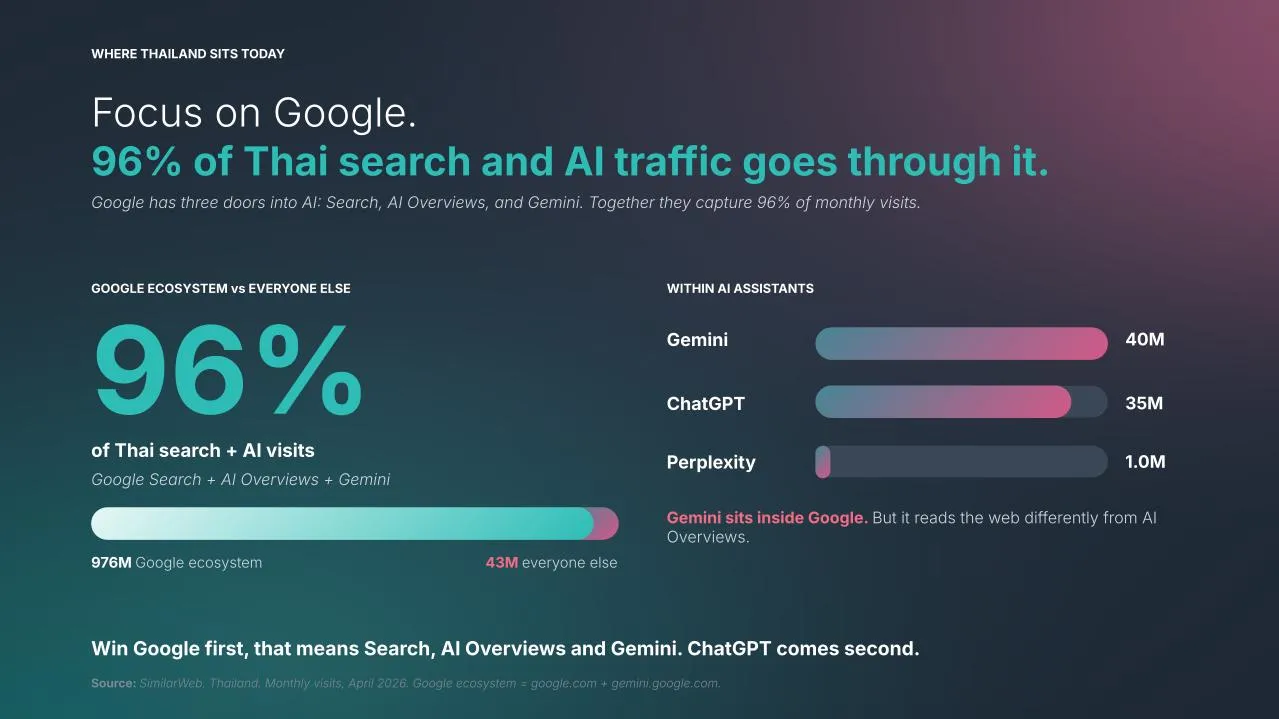
As of April 2026, 96% of Thai search and AI traffic flows through Google’s ecosystem, which is Google Search plus AI Overviews plus Gemini combined. The other 4% is ChatGPT, Bing, Perplexity, and everyone else, all sharing what’s left.
| Platform | Thailand monthly visits, April 2026 |
|---|---|
| Gemini | ~40M |
| ChatGPT | ~35M |
| Bing | ~7M |
| Perplexity | ~1M |
Source: SimilarWeb, April 2026.
AI Overviews now sits on top of most Google searches in Thailand. A user types a query, the AI answer shows up above the blue links, and a meaningful chunk of users never scrolls past it. The click-through to your site is already lower than it was twelve months ago, and the trend is only going one way.
Implication: any Thai AI search strategy has to start with Google’s stack. Optimising only for ChatGPT misses the room in Thailand entirely.
Key takeaways:
- 96% of Thai AI search traffic sits inside Google’s ecosystem.
- Gemini already has more Thai traffic than ChatGPT.
- AI Overviews is now the default top result on most Thai Google searches.
2. AI Mode is the next default
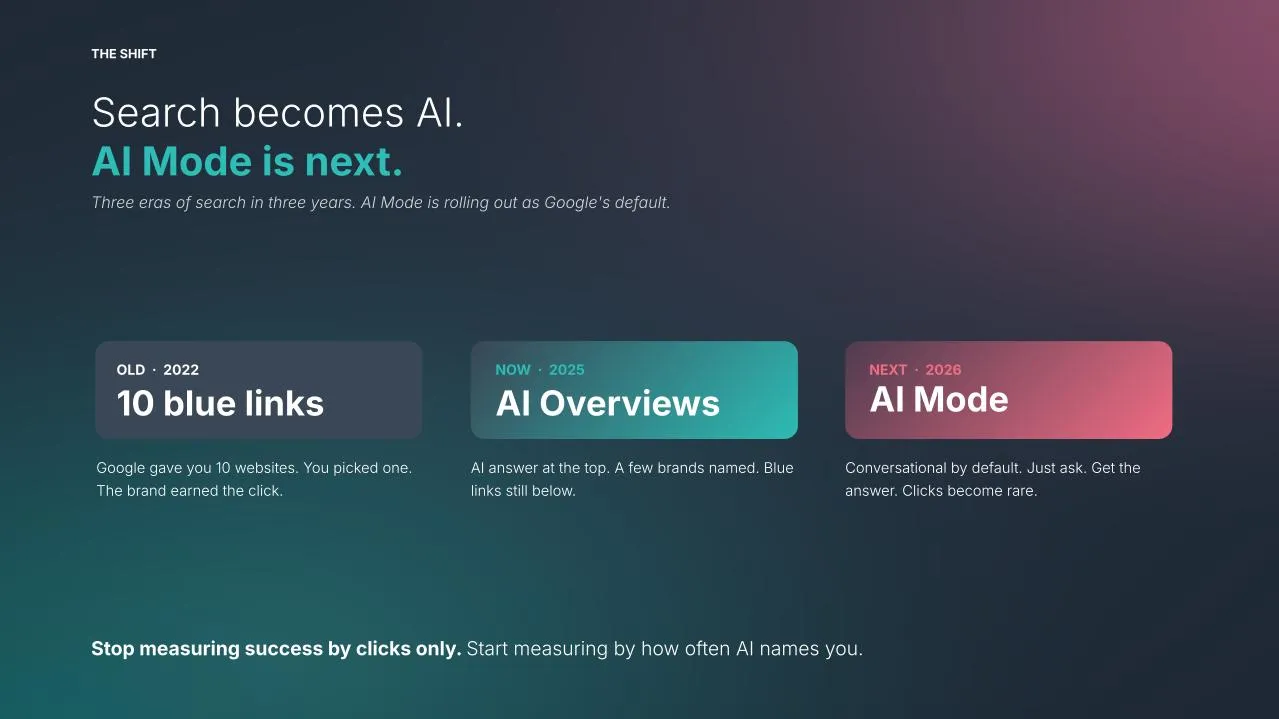
The third era of search in three years is rolling out now. Google AI Mode, which is conversational by default, is becoming Google’s new search experience through 2026.
- Blue links → before 2024
- AI Overviews → 2025
- AI Mode → 2026
Each era moved the AI answer from being a step on the way to your site to being the destination itself, and click-throughs keep falling as a result. The only metric that matters now is whether your brand shows up in the answer at all.
Implication: the click-through-to-site model is dying. The brand-visibility-in-AI-answers model is what replaces it, and the time to start measuring it was eighteen months ago. The next-best time is now.
Key takeaways:
- AI Mode is the third major search shift in three years.
- Click-through rates are going one way.
- Brand visibility inside the AI answer is the metric that matters in the new era.
3. Two brands take 71% of AI mentions
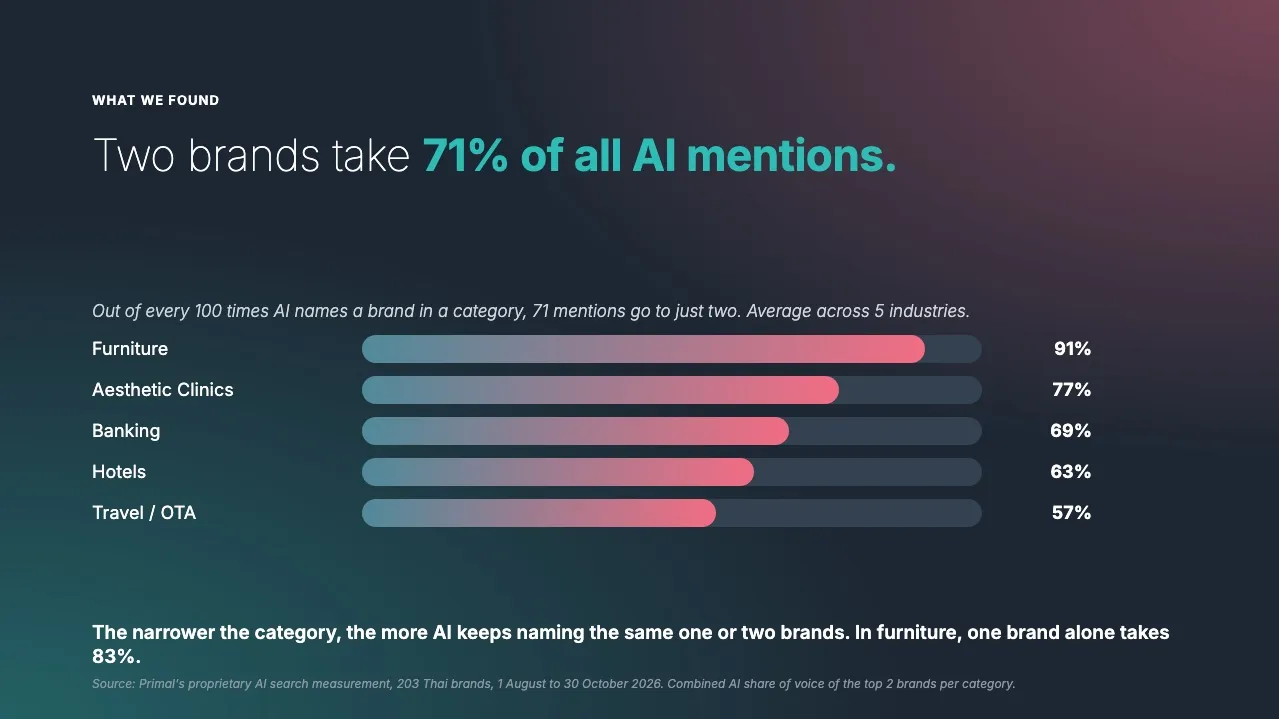
Across the five Thai industries we measured, the top 2 brands per category capture an average of 71% of AI brand mentions. That leaves the remaining 29% to be shared by everyone else in the category combined.
| Industry | Top 2 brands’ share of AI mentions |
|---|---|
| Furniture | 91% |
| Aesthetic clinics | 77% |
| Banking | 69% |
| Hotels (Bangkok luxury) | 63% |
| Travel and OTA | 57% |
The narrower the category, the closer the AI answer gets to winner-take-all. Furniture is the extreme case. Two brands take 91% of mentions between them, and one brand alone takes 83%, leaving 9% for everyone else combined.
Implication: in most Thai categories, if you are not in the top 2, AI effectively does not see you. The top-2 lock is harder to break the narrower your category gets.
Key takeaways:
- The top 2 brands per category own 71% of AI mentions on average.
- The narrower the category, the closer to winner-take-all (furniture: 91%).
- Below top-2, AI visibility tapers off sharply.
4. AI quotes other people about you, not you
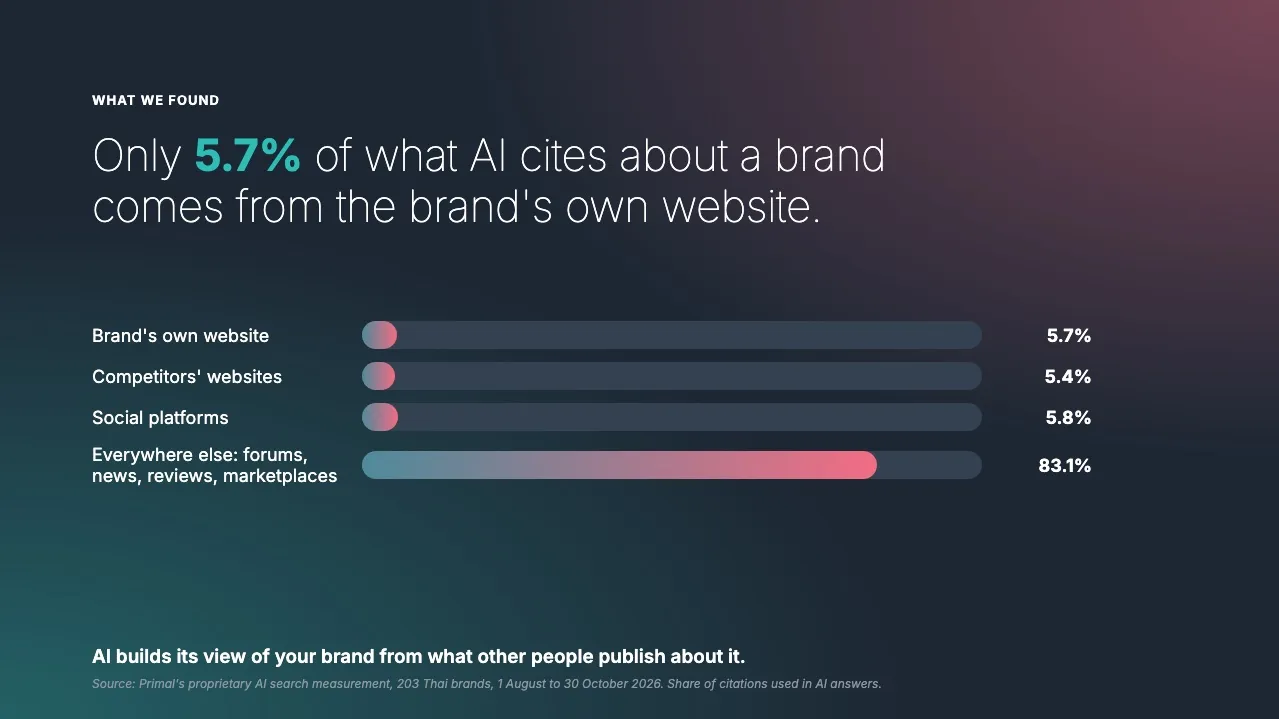
This is the finding that breaks most of the marketing playbooks brands are running today. Across the 203-brand portfolio, only 5.7% of what AI cited about a brand came from the brand’s own website. The remaining 94% came from sources the brand does not own, competitors’ websites included.
| Source of AI citations about a brand | Share |
|---|---|
| Brand’s own website | 5.7% |
| Competitors’ websites | 5.4% |
| Social platforms | 5.8% |
| Everywhere else (forums, news, reviews, marketplaces) | 83.1% |
In other words, you can’t win AI search in Thailand by writing more posts on your own blog. That lever, on its own, is worth about six percentage points at best.
Implication: the playbook is not on-site content. It is brand presence across the wider web. Investing more in your own blog while the other 94% sits unmanaged is the most common mistake we see.
Key takeaways:
- 94% of your AI citations come from sites you do not own.
- Your own website is worth under 6% of your AI citations.
- The lever that matters is presence across the wider web, not more on-site content.
5. AI’s top 10 sources for Thai brands
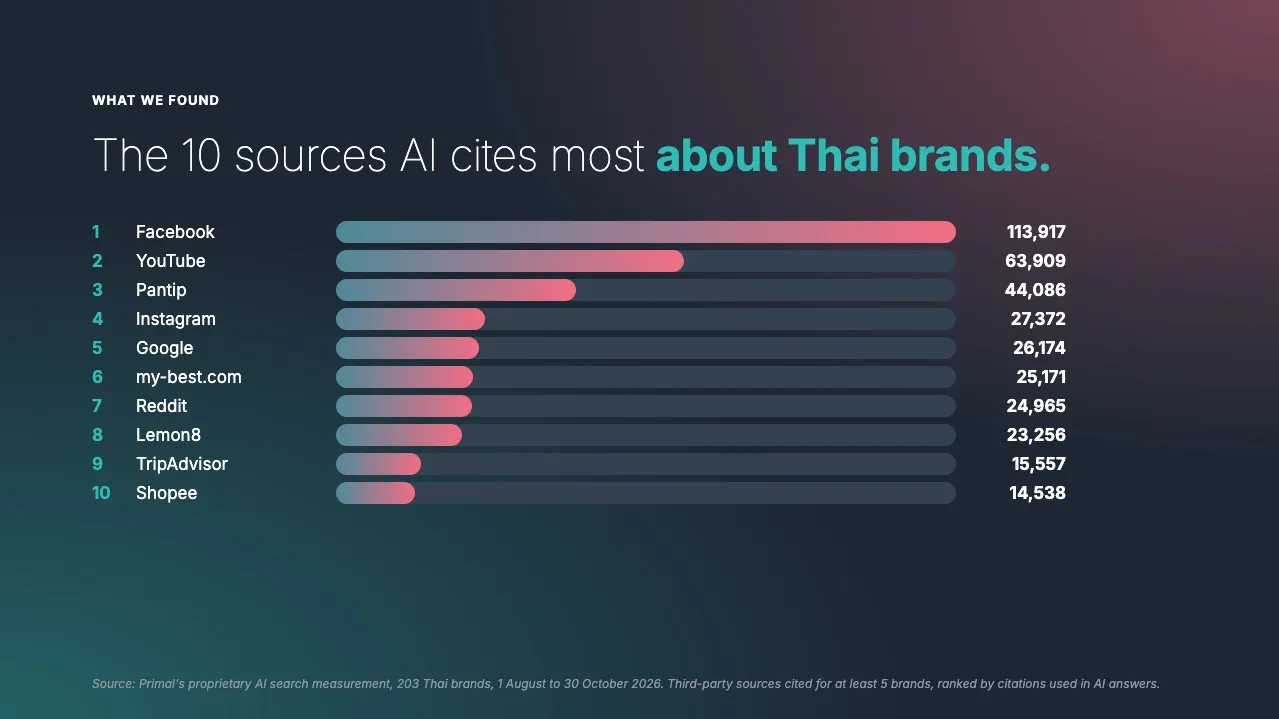
Across the portfolio over 91 days, ranked by how often AI quoted them (third-party sources cited for at least five brands), the top 10 sources looked like this.
| Rank | Source | Citations |
|---|---|---|
| 1 | 113,917 | |
| 2 | YouTube | 63,909 |
| 3 | Pantip | 44,086 |
| 4 | 27,372 | |
| 5 | 26,174 | |
| 6 | my-best.com | 25,171 |
| 7 | 24,965 | |
| 8 | Lemon8 | 23,256 |
| 9 | TripAdvisor | 15,557 |
| 10 | Shopee | 14,538 |
Pantip, the Thai forum, is third, ahead of Instagram, Google and Reddit. mybest’s Thai edition and Shopee are in the ten, Lemon8 is new to it, and Thai Rath, Wongnai and Kapook sit just below. Most Thai marketers we work with have never run a coordinated presence campaign on any of them.
Implication: a Thai AI search strategy is not the global SEO playbook. The local sources matter as much as the global ones, and your international competitors will not touch them, because they don’t yet know these sites exist.
Key takeaways:
- Facebook and YouTube are the two largest single sources AI cites in Thailand.
- Pantip, mybest, Shopee, Lemon8, Thai Rath, Wongnai and Kapook are the local channels AI is actively reading.
- The Thai local layer is the part of the playbook the global guides leave out.
6. The mybest surprise
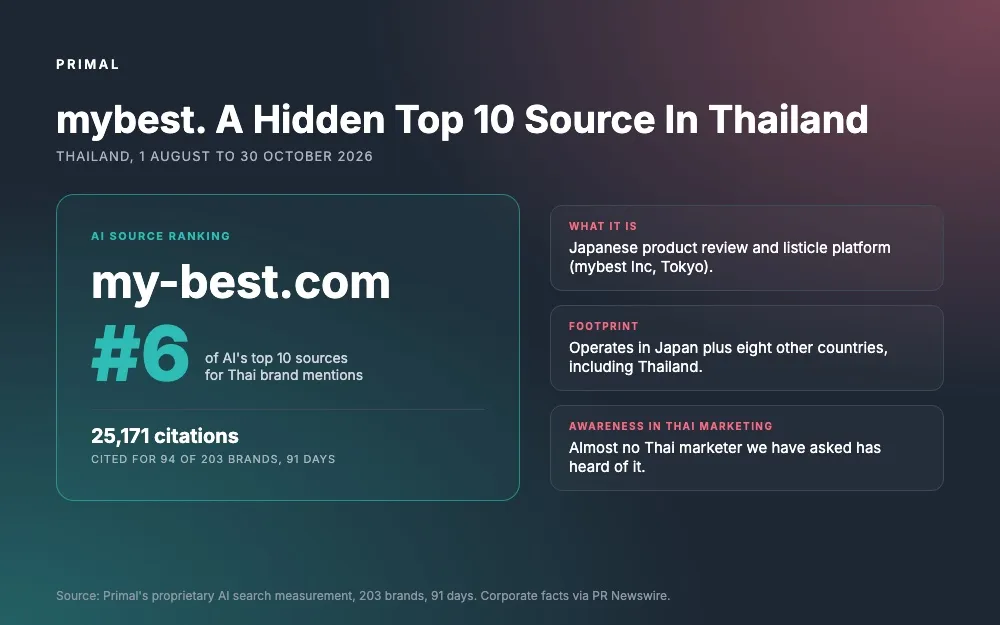
Sitting at #6 in AI’s top 10 sources about Thai brands, up from #8 in our first edition, is my-best.com, a Japanese product review and listicle platform (mybest Inc, Tokyo) that operates in Japan plus eight other countries, including Thailand. Almost no Thai marketer we have asked has ever heard of it.
If you’re a Thai brand in a category mybest covers, mybest is shaping what AI says about you, and you have zero presence on it. That’s a real gap with a real fix.
Implication: there are sites quietly shaping AI answers about your brand that you don’t even know exist. The first job is to find them. The second job is to be on them.
Key takeaways:
- mybest is a Japanese listicle platform that ranks #6 in AI sources about Thai brands.
- Almost no Thai brand we have worked with has had any presence on it.
- Discovery of these hidden sources is itself an underrated competitive lever.
7. AI doesn’t have a top 10. It pulls from 91,000 sources.
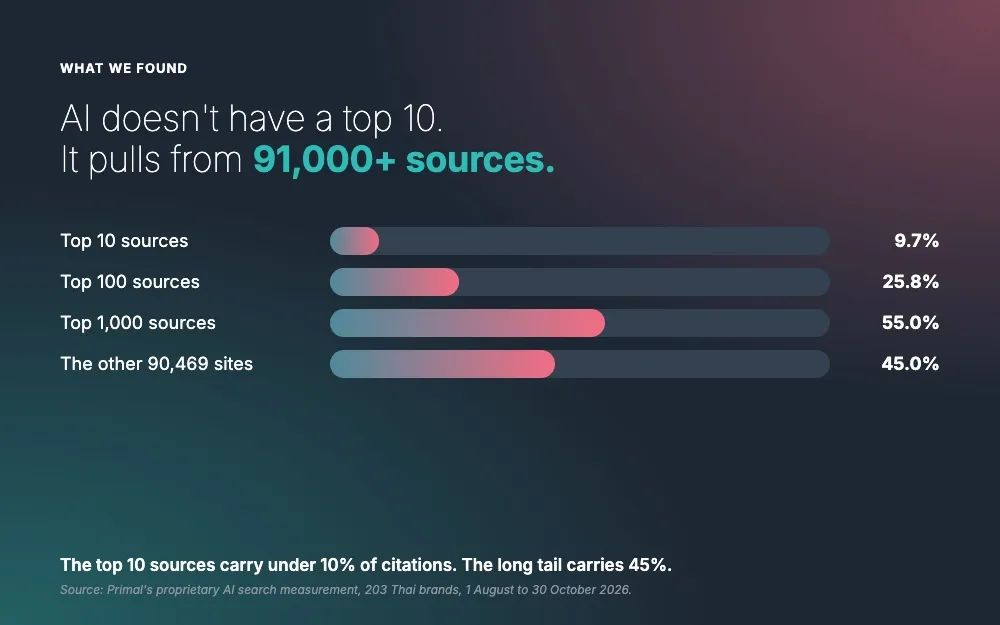
The top 10 sources don’t carry the report on their own. They cover only 9.7% of AI’s brand citations. The top 100 cover 25.8%. The top 1,000 cover 55%. The remaining 45% is spread across more than 90,000 other sites.
| Source set | Share of AI citations |
|---|---|
| Top 10 sources | 9.7% |
| Top 100 | 25.8% |
| Top 1,000 | 55% |
| The other 90,469 sites | 45% |
Your brand can show up anywhere AI is looking, which means optimising only for the top 10 leaves about 90% of the citation surface on the table.
Implication: brand presence has to be wide as well as deep. Concentrating your effort on the top 10 will not get you in the answer when AI samples from the long tail, which it does in close to half of all citations.
Key takeaways:
- The top 10 sources cover under 10% of citations.
- The long tail of 90,000+ other sites accounts for 45%.
- Width of presence matters as much as depth.
8. Google AI and ChatGPT quote different websites
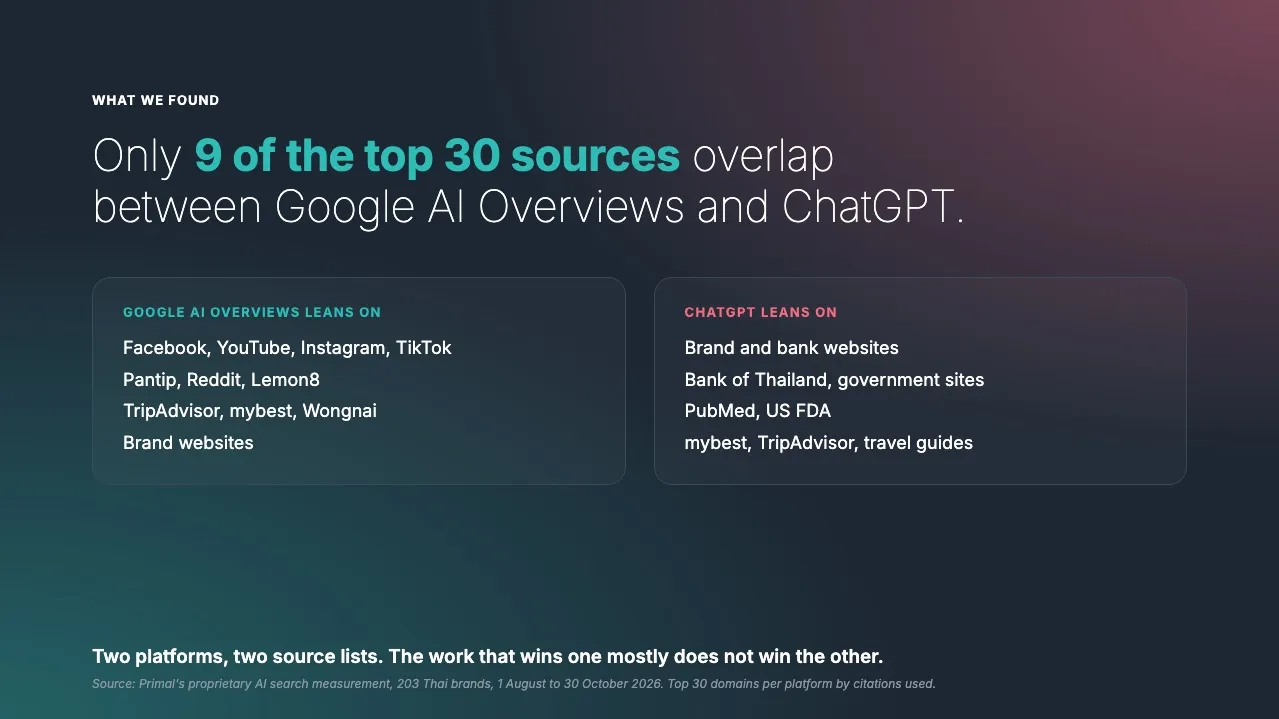
The instinct is to treat “AI search” as a single channel, but the data does not back that up. Of the top 30 sources Google AI Overviews quotes from, and the top 30 ChatGPT quotes from, only 9 sources overlap. The other 21 on each side are different sites.
| Platform | What it leans on |
|---|---|
| Google AI Overviews | Social platforms (Facebook, YouTube, Instagram, TikTok), Pantip, Reddit and Lemon8, brand-owned domains, and aggregators (mybest, TripAdvisor). It mostly surfaces what already ranks in Google. |
| ChatGPT | Official and institutional sources (brand and bank websites, the Bank of Thailand, government sites, PubMed, the US FDA), plus mybest and TripAdvisor. No Meta property in its top 30. |
Two systems, two diets. Optimising YouTube and Facebook presence pulls Google AI Overviews, but it barely moves ChatGPT. Accurate official pages and citations from institutional sources move ChatGPT, but Google AI cares less.
Implication: winning on Google AI Overviews is a different game from winning on ChatGPT. Brands need two playbooks, not one, and the work that wins one mostly does not win the other.
Key takeaways:
- Only 9 of the top 30 sources overlap between the two platforms.
- Google AI Overviews leans on social platforms, Pantip and brand-owned domains.
- ChatGPT leans on official websites and institutional sources.
9. Gemini behaves like Google AI, not ChatGPT
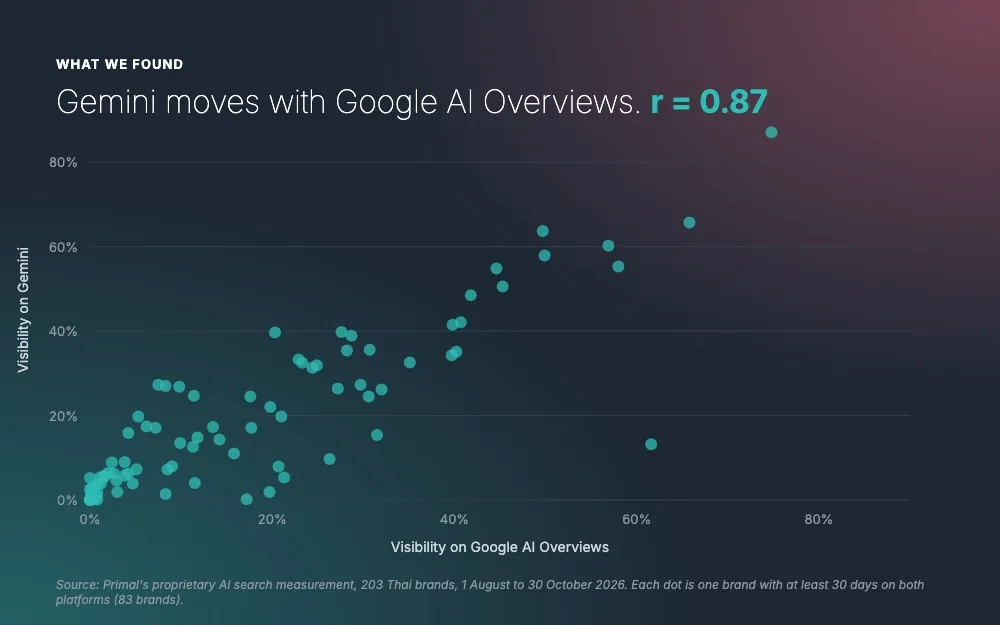
Gemini is Google’s chat product, so the reasonable assumption is that Gemini behaves like Google AI Overviews. In our first edition, on three brands with clean data, it looked the other way round. With 83 brands now measured on both platforms, the answer is clear. It does behave like Google AI.
Across those 83 brands, the correlation between Google AI Overviews visibility and Gemini visibility came out at r = 0.87 (a number close to 1 means the two rise and fall together). Strong brands are strong on every platform, so Gemini and ChatGPT also correlate (r = 0.77). The difference is the level. On the same brands, average visibility was 20.1% on Gemini, 18.4% on Google AI Overviews and 13.5% on ChatGPT.
Implication: Gemini runs on the Google AI playbook. ChatGPT is the platform that needs its own.
Key takeaways:
- Gemini visibility tracks Google AI Overviews visibility (r = 0.87, 83 brands).
- Gemini gives brands about the same visibility as Google AI Overviews. ChatGPT gives less.
- Run Gemini with the Google AI work, and give ChatGPT separate work of its own.
10. Winning Google AI does not win ChatGPT
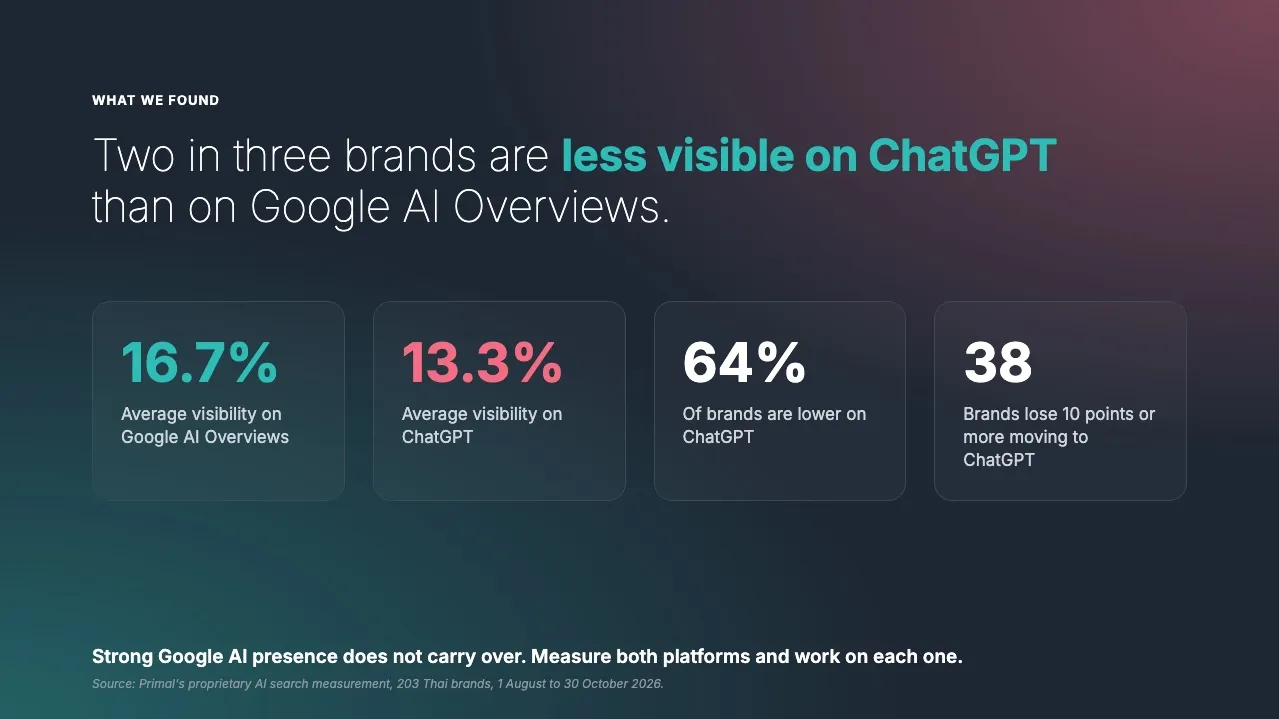
Strong visibility on Google AI Overviews does not transfer to ChatGPT. Across the 203 brands, average visibility is 16.7% on Google AI Overviews and 13.3% on ChatGPT. Two in three brands are less visible on ChatGPT, 38 of them lose 10 points or more moving from one to the other, and 11 lose 20 points or more.
Being a top 2 brand in your category on Google AI does not buy you a top 2 spot on ChatGPT, because the two platforms are asking different questions of different sources. Even strong Google AI presence is not a hedge for ChatGPT. ChatGPT is the harder room.
Implication: a brand can dominate Google AI in Thailand and still be invisible on ChatGPT. Plan for both. Measure both. The cross-platform gap is the single most under-appreciated number in AI search right now.
Key takeaways:
- Two in three brands are less visible on ChatGPT than on Google AI Overviews.
- 38 of 203 brands lose 10 points or more, and 11 lose 20 points or more.
- Strong Google AI presence is not a hedge. The two platforms are independent races.
So how do Thai brands actually win
The ten findings translate into five moves, in the order we’d run them.
First, map your category honestly. Identify the two brands that own the AI answer in your space today, and the assets that put them there. Usually that’s some combination of strong YouTube presence, an active Pantip footprint, recurring news mentions, a Wikipedia entry, and inclusion in a mybest listicle. If the gap between your visibility and the top 2 is 70 percentage points, that gap is closeable. It is not closeable by writing more on-site content.
Second, build coordinated presence on the Thai local sources AI is quoting from. That’s Pantip, Wongnai, Kapook, mybest, Shopee, and the regional review sites in your category. This is the lever the global playbook misses entirely, and it’s the lever your international competitors will not touch, because they don’t yet know these sites matter.
Third, build a YouTube and Facebook layer for Google AI Overviews and Gemini. Branded video content, Q&A-format videos, and Facebook posts that get cited will pull Google AI and Gemini specifically. This layer does very little for ChatGPT, which is fine. Different tool for a different platform.
Fourth, build an official and institutional layer for ChatGPT. The sources ChatGPT quotes (your own official pages, bank, regulator and government sites, research sources, and review platforms like mybest and TripAdvisor) take longer to compound than social-platform content. Which is exactly why the brands that start now will be hard to dislodge a year from now.
Fifth, measure daily. The brands that show up in AI answers twelve months from now will be the ones that started tracking AI citations daily in 2026. The brands that don’t will be the ones that waited for AI search to “settle”. Every previous search transition (organic in the late 2000s, mobile in the early 2010s, voice in the late 2010s) followed the same shape. The brands measuring first set the benchmarks the rest of the category eventually has to match.
Implication: the lever is not “more content”. The lever is brand presence on the right sources for the right platforms, measured daily, with two playbooks running in parallel.
Closing
If there’s one takeaway from this report, it’s that AI is not deciding who wins in Thailand based on your website. The decision has already been made, on the basis of everyone else’s content about you. The brands that move first will not move on writing more blog posts. They will move on the 94% of AI citations they don’t currently control. The window where this work is uncontested is short, probably twelve months. By 18 months from now, every category will have someone running the local-source playbook. By 24 months, the top 2 in every category will be locked, in the same way the top 2 organic SEO positions were locked from 2010 onwards.
If you want to see where your brand stands right now across Google AI Overviews, ChatGPT, and Gemini for your category in Thailand, the fastest way is a free AI search audit at audit.prml.com. Five minutes, a tracked database of 1,500+ brands, and a follow-up conversation with our team if the gap to top 2 looks closeable. For anyone at MarketingOops on 11 June 2026, the full version of this research is the keynote, with the playbook in detail. Otherwise the data above is what we walk every client through on the audit call.
The next twelve months will decide the next decade of brand visibility in Thailand. The work that closes that gap starts now.
Founder and Chief Executive Officer
Mark McDowell is the Founder and Chief Executive Officer of Primal, which he started in Bangkok in 2015. He is on the Forbes 30 Under 30 Asia 2020 list and was Campaign Asia’s Southeast Asia Young Achiever of the Year in 2018. He writes about AI search and search engine optimisation.
About The Author